

Abstract
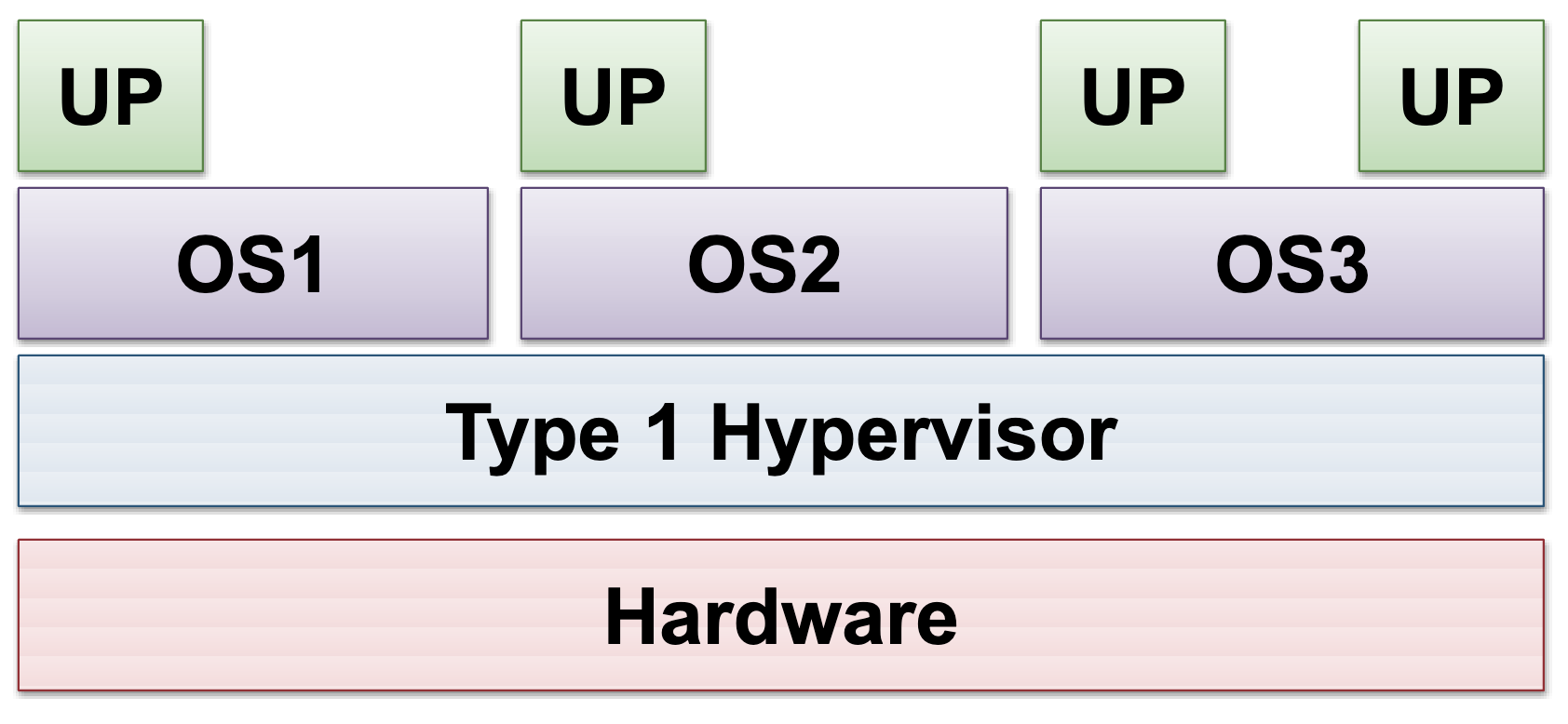
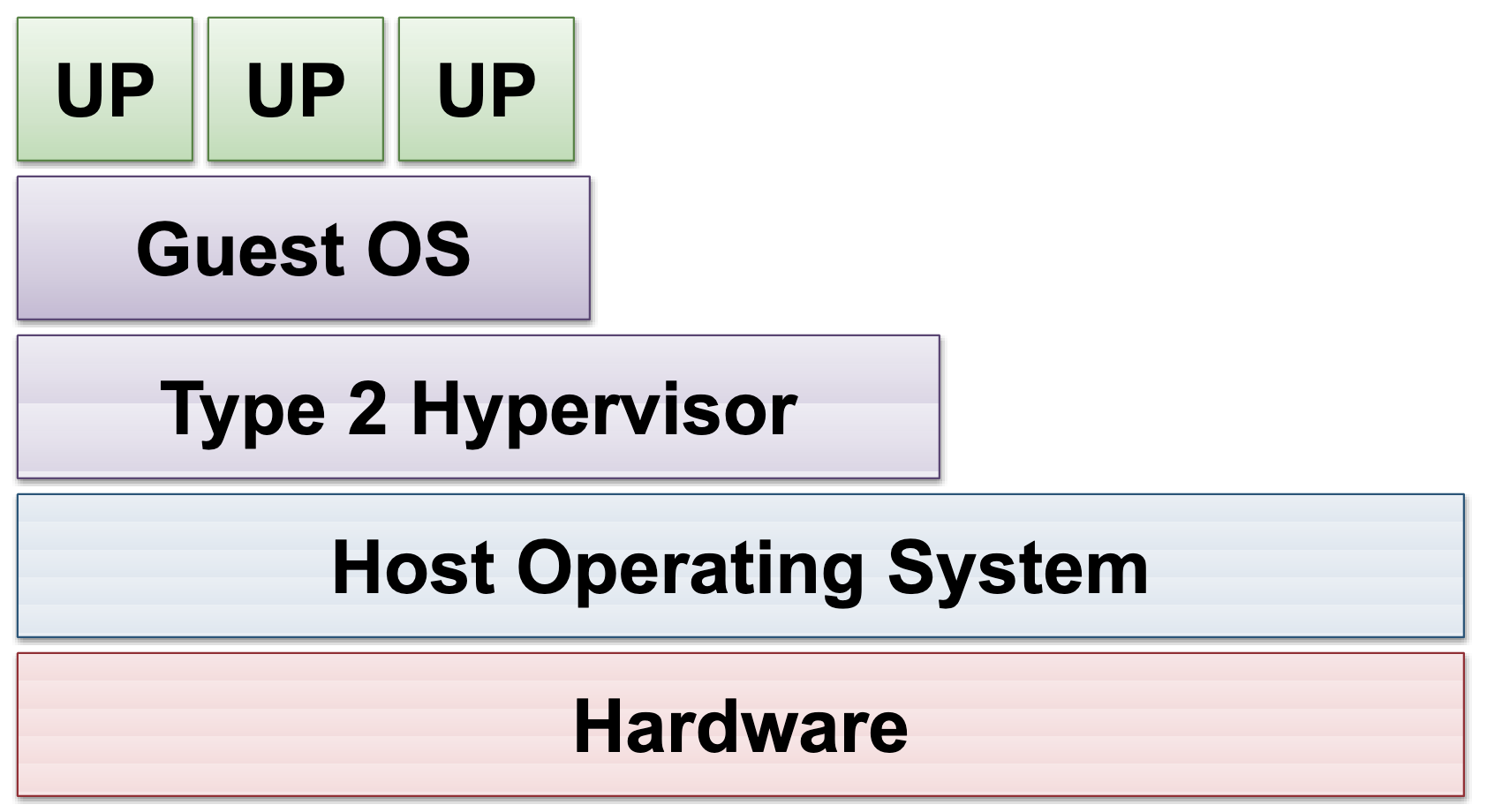
- Virtualisation is a software emulation of hardware, allowing multiple OS to run inside a host OS
- More broadly, isolation is a spectrum of techniques from lightweight process-level sandboxes to full hardware-level VMs
Type 1 hypervisor
Type 2 hypervisor
Isolation Spectrum
- Different workloads need different trade-offs between isolation strength, performance, and flexibility
V8 Isolates (workerd)      ← process-level, lightest, JS/WASM only
       ↓
Containers (Docker/runc)   ← OS-level, shared kernel, namespaces + cgroups
       ↓
gVisor (Sentry)            ← user-space kernel, stronger than containers
       ↓
Firecracker (microVM)      ← hardware-level via KVM, own guest kernel
       ↓
QEMU (full VM)             ← full machine emulation, heaviest
V8 Isolates
- The lightest form of isolation. Each isolate is a sandboxed instance of the V8 JavaScript engine (the same engine in Chrome and Node.js), running in its own memory space within a single process
- Supports JavaScript, TypeScript, and WebAssembly (compiled from Rust, C, Go, etc.), but cannot run arbitrary system commands or access the filesystem
- Cloudflare Workers uses this model via workerd, their open-source V8-based runtime. Multiple Workers run as separate isolates within the same process, making cold starts near-instant (milliseconds) with minimal memory overhead
- The trade-off: fast and efficient, but restricted. No system calls, no arbitrary binaries. For workloads that need a full Linux environment, Firecracker or gVisor is needed
Device Model
- In virtualisation, a device model is the set of virtual hardware devices that the hypervisor presents to the guest VM. This includes things like virtual network cards, virtual disks, serial consoles, and USB controllers. These are emulated versions of real IO devices
- The guest VM interacts with these virtual devices as if they were real hardware, but the hypervisor translates those interactions to the actual host hardware via the Device Controller
- A larger device model (more virtual devices) means more code paths, which increases the attack surface. Firecracker deliberately uses a minimal device model (virtio-net, virtio-block, serial console) with no USB controllers, no PCI bus, and no GPU support
PCI Passthrough
- A technique that lets a VM directly access a physical PCI device (like a GPU) on the host via the PCI bus, bypassing the hypervisor for near-native performance
- The VM talks directly to the hardware through the host’s PCI bus, so the hypervisor is not in the data path
- Firecracker does not support PCI passthrough because it does not emulate a PCI bus at all. This is a deliberate design choice to keep the Device Model minimal. As a result, Firecracker microVMs cannot use GPUs
- gVisor takes a different approach with NVProxy, intercepting GPU calls at the syscall level instead of using PCI passthrough
Firecracker
- Firecracker runs microVMs, which are extremely lightweight virtual machines that run on top of KVM (Kernel-based Virtual Machine)
- KVM is a Linux kernel module that turns the host kernel into a type 1 hypervisor. Similar to how FUSE is a kernel module that enables user-space filesystems, KVM is a kernel module that enables the kernel to manage virtual machines
- Each microVM runs its own separate guest kernel, providing hardware-level isolation that’s much stronger than container (OS-level) isolation
- Because they boot extremely fast and use very little memory, they’re used by AWS Lambda and AWS Fargate to safely run multi-tenant workloads at massive scale
KVM as an attack surface
MicroVMs still go through KVM and the host kernel to access hardware: guest kernel → hypercall → KVM → host kernel → hardware. This means KVM is part of the attack surface. A vulnerability in KVM could theoretically allow an attacker to escape the microVM.
This risk is mitigated by:
- KVM’s codebase is small and heavily audited (it’s in the mainline Linux kernel)
- Firecracker’s minimal Device Model reduces code paths that could be exploited
- Firecracker uses seccomp filters and a jailer process to restrict what the VMM process itself can do, even if compromised
gVisor
- gVisor is a container runtime that improves security by running applications inside a user-space kernel called Sentry, which intercepts and emulates system calls instead of letting them reach the host kernel directly
runscis gVisor’s runtime binary that replaces Docker’s defaultrunc. It is responsible for setting up and launching the Sentry kernel inside the sandbox.runscis the runtime, Sentry is the user-space kernel- This design greatly reduces the attack surface and protects the host from compromised containers, though it comes with some performance overhead
- In the Isolation Spectrum, gVisor sits between regular containers and Firecracker. It offers stronger isolation than Linux Namespace + cgroups alone, but less than hardware-based microVMs
NVProxy
- gVisor’s GPU bridge that intercepts CUDA calls from the sandbox and proxies them to the host’s NVIDIA driver. This is possible because gVisor operates at the syscall level, allowing it to selectively forward GPU-related calls while still sandboxing everything else
- Firecracker cannot do this because its minimal Device Model lacks PCI Passthrough entirely
- Despite some overhead from the proxying layer, NVProxy supports most CUDA-based AI workloads effectively, making gVisor suitable for secure GPU compute where slight speed trade-offs are acceptable
Virtualisation Tools
Vagrant
- A piece of software to manage VMs with ease
- Install VirtualBox
- Install Vagrant
brew tap hashicorp/tap
brew install hashicorp/tap/hashicorp-vagrant
vagrant plugin install vagrant-share
QEMU
- Powerful open-source machine emulator and virtualizer
brew install qemu